Motorcycle Helmets in 2026: The Definitive Buying and Safety Guide
Discover everything you need to know before buying your next motorcycle helmet: regulations (ECE 22.06 vs DOT), materials, types, and the best brands on the market to guarantee your safety without overpaying.
Choosing a good motorcycle helmet is no small decision, as it is the most important piece of equipment for any rider. Faced with the immense variety of options, regulations, and prices, choosing the right one can be overwhelming. In this definitive guide, we explain everything you need to know before buying your next helmet.
1. Types of Helmets: Which One Suits Your Style?
The helmet's architecture defines its functionality and the level of protection it will offer you:
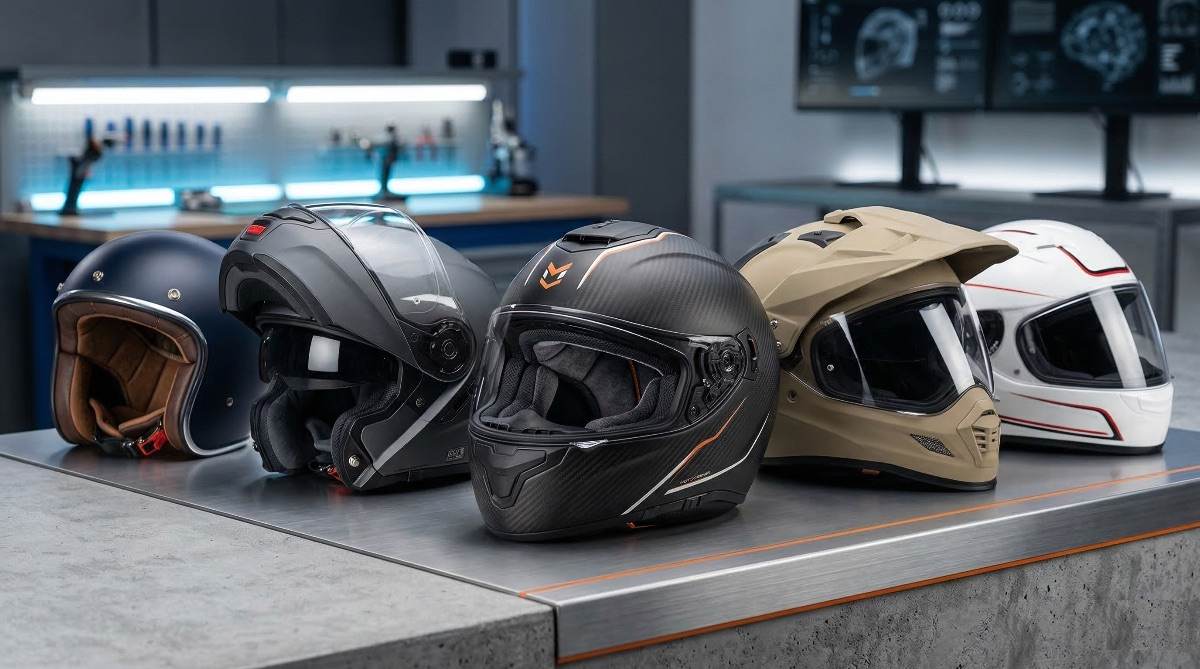
- Full-face: These are considered the gold standard in safety. By having a shell made in one piece, they offer maximum structural rigidity and total coverage for the head, face, and jaw.
- Modular (Flip-up): Ideal for touring and urban use, as they allow the chin bar to be raised at stops. If you opt for one, it is crucial to verify that it has double P/J homologation, which certifies that it is legal and safe to ride with both the chin bar raised and lowered.
- Jet (Open-face): Popular for urban commutes and scooters due to their lightness and ventilation. However, they lack facial protection, making them vulnerable to frontal impacts. If you don't know what to choose for your first motorcycle, here are some tips for your first motorcycle.
- Dual Sport / Adventure: A perfect hybrid option for Trail motorcycles. They combine the protection of a full-face helmet with a sun visor and a design that facilitates breathing during physical exertion.
2. Homologations: The ECE 22.06 Standard Revolution
Homologation is the only real guarantee that the helmet will fulfill its function. In Europe, the strictest current regulation is ECE/ONU R22.06. This new standard is much more rigorous than its predecessor (22.05):
- More impact zones: It evaluates resistance at 18 random impact points, compared to the 6 fixed points of the previous standard.
- Different speeds: It tests energy absorption at low speed (6 m/s), standard speed (7.5 m/s), and high energy (8.2 m/s) to simulate more realistic accidents.
- Rotational impacts: It introduces tests against an angled anvil to measure and mitigate torsional forces transmitted to the brain, a frequent cause of brain damage.
- Tests with accessories: The helmet is evaluated with all its accessories installed (such as intercoms or sun visors) to ensure they do not weaken the structure. The DGT 2026 regulation on mandatory equipment is also important.
And what about DOT certification? The DOT standard is the required regulation in the United States. It focuses mainly on linear frontal impacts and allows manufacturers to "self-certify." It is much more basic and less strict than the European ECE 22.06.
3. Materials and Prices: Is More Expensive Always Better?
It is a mistake to think that an 800 euro helmet will protect you much more than a 100 euro one. If both comply with ECE 22.06, both are safe. The price difference (ranging from entry-level at €100-€180 to premium at over €500) lies in the materials and comfort:
- Polycarbonate / ABS: Entry-level material, very resistant but heavier. Helmets like the HJC C10 or the Scorpion Exo-391 (around €100) offer 22.06 homologation with polycarbonate shells, making them excellent budget-friendly options.
- Fiberglass and composites: Offer excellent energy dissipation with medium weight, falling into the €200 to €450 segment.
- Carbon fiber: The premium material. It provides maximum rigidity with ultralight weight, reducing neck fatigue. Here you pay for superior aerodynamics, soundproofing, and high-end interiors. You can find many of these motorcycles in the new motorcycles section.
4. The Best Brands on the Market
Investment in R&D makes the difference. Some of the most recommended brands for their reliability are:
- Shoei and Arai: The absolute benchmarks in safety, solid construction, and comfort.
- AGV: Stands out for its striking designs, aerodynamics, and technology geared towards racing.
- Shark: A French brand chosen by professional riders, which uses very light materials and proprietary safety systems.
- Bell: Shines for its ergonomics and retro-style models (like the Bullitt) with modern technology.
- HJC and LS2: The undisputed queens of value for money, offering high protection at affordable prices.
5. How to Check the Homologation Label?
Open the helmet and look for the internal white label. On it, you should find:
- A capital "E" indicating European homologation, followed by a number (9 corresponds to Spain).
- A code starting with 05 (ECE 22.05) or 06 (ECE 22.06).
- A protection letter: P (Chin bar protection, full-face), J (Jet, open-face), or P/J (Double homologation for modular).
Final Buying Tips
- Perfect Fit: Not all heads have the same shape, nor do all brands fit the same. The helmet should fit snugly without causing pain. You can find experts in motorcycle shops and workshops.
- Sun Visor: An integrated internal sun visor is extremely useful to avoid carrying additional sunglasses.
- Be Careful Buying Used: Internal materials lose absorption properties after an impact or due to the passage of time. Also, beware of motorcycle sales scams.
Este artículo y su imagen se han elaborado apoyándose en la inteligencia artificial y siendo revisados por el equipo de MotoCorner antes de publicarse. Las imágenes son ilustrativas y pueden no corresponder a modelos o piezas reales.