Motorcycle Protective Gear in 2026: Materials, CE Labels, and New DGT Regulations
Discover the DGT's obligations for motorcyclists, learn to decipher the CE labels on your equipment, and get to know the latest generation materials (Kevlar, UHMWPE, Superfabric) that compete with leather.
The world of motorcycle gear has become unprecedentedly professionalized. Gone are the days when a simple leather jacket and street jeans seemed sufficient. Nowadays, safety is no longer optional; it's a technical requirement validated by laboratories and increasingly demanded by law.
If you want to know if the gear you're wearing will truly protect you in a fall or if you risk a fine with the new regulations, this guide is for you.
1. Legal Updates: The Strict DGT Regulations in 2026
The Dirección General de Tráfico (DGT) has implemented significant safety reforms that fully came into effect in January 2026. You can find all the details in our Guide to DGT 2026 Regulations for Motorcycles. Freedom on the road now comes with clear obligations:
- Mandatory Certified Gloves: Riding on interurban roads will require the mandatory use of gloves certified under the European standard EN 13594. Failure to do so can result in fines of 200 euros and license point deductions. Fingerless or wool gloves are a thing of the past.
- Closed Footwear: The new regulations strictly prohibit riding in flip-flops, sandals, or any loosely fastened footwear. You must wear footwear that completely covers the foot and ankle, with boots certified EN 13634 being highly recommended, as they pass tests for transverse rigidity, cut resistance, and abrasion resistance.
2. Leather vs. Textiles: The Material Revolution
Historically, cowhide or kangaroo leather has been the undisputed king due to its tremendous abrasion resistance. However, innovation in synthetic fabrics is unstoppable, and today they compete head-to-head with leather, offering advantages in weight, waterproofing, and comfort. For more gear tips, visit our Motorcycle Forum.
- Cordura: Created by DuPont, it's a highly tear and abrasion-resistant nylon 6-6 (polyamide). It's the quintessential synthetic material in Touring jackets, with its toughness varying according to its density (e.g., Cordura 500D or 1100D).
- Kevlar: This polyamide is 5 times stronger than steel for the same weight. Being extremely resistant to heat and tensile strength, it's often used as a protective inner lining or in critical areas of motorcycle jeans.
- UHMWPE (Ultra-High Molecular Weight Polyethylene): An aerospace technology material that allows for the creation of extremely lightweight single-layer garments (like jeans or jackets) that achieve the maximum protection level (AAA).
- Superfabric: This is a true modular armor. It consists of a nylon base coated with tiny ceramic plates that disperse impact energy and offer extreme resistance.
3. Understanding CE Labels: What Do the Letters Mean?
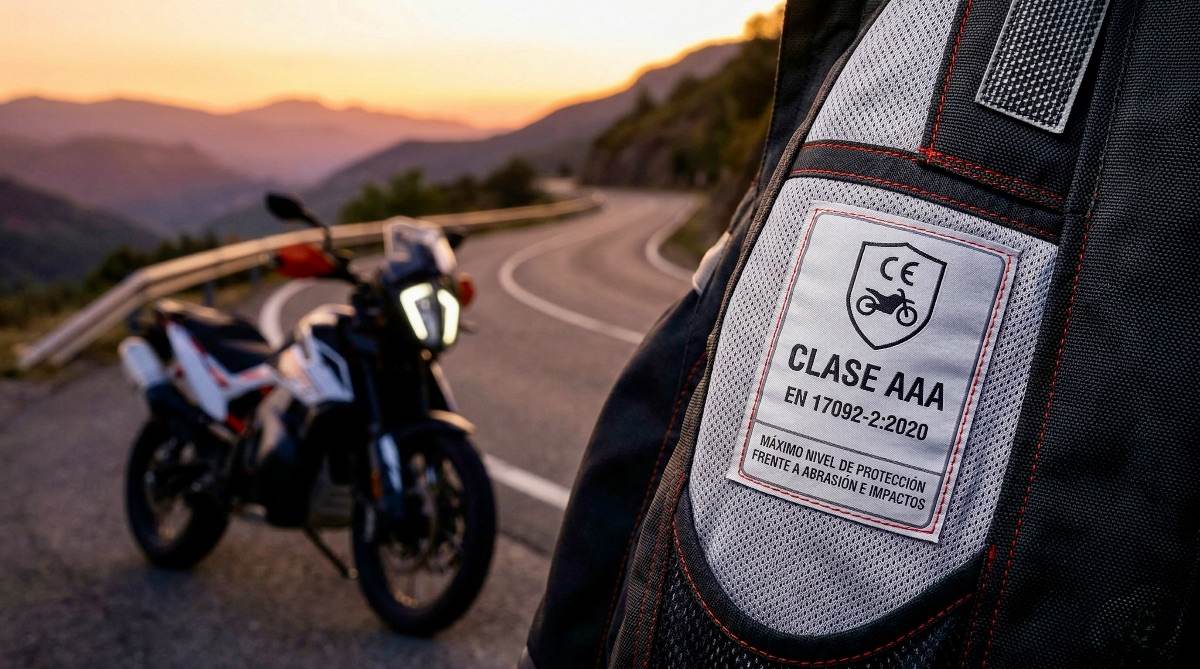
All gear sold as "motorcycle clothing" must be considered Personal Protective Equipment (PPE) and bear the CE marking. The standard governing jackets and pants is EN 17092, which classifies garments into five categories after subjecting them to abrasion and seam strength tests on laboratory machines (like the Darmstadt machine). You can find certified motorcycle gear deals.
- Class AAA: The highest possible protection against impact and abrasion. Designed for racing, track days, or high speeds on the road.
- Class AA: High protection. It's the perfect balance for most riders who do road motorcycle tours or touring.
- Class A: Moderate protection. Ideal for urban use and medium speeds, offering maximum comfort and lightness.
- Class B: Garments that only offer abrasion resistance but do not include impact protection (elbows, shoulders). You must use separate armor.
- Class C: Mesh innerwear designed solely to hold impact protectors. They offer no abrasion resistance and must therefore always be worn under Class AAA, AA, A, or B garments.
4. Internal Protectors (EN 1621): Level 1 vs Level 2
In addition to the fabric, the armor you wear on your elbows, shoulders, knees, and back is your shield against fractures. These are governed by the EN 1621 standard.
The most critical aspect of any protector is its energy absorption capacity. In the lab, a 5 kg weight is dropped from a height of one meter with an energy of 50 Joules. Here, it's vital to understand the difference:
- Level 1: Transmits a maximum force to the body of 35 kN (on limbs) or 18 kN (on the back). This is basic protection.
- Level 2: These are superior and highly recommended. They absorb much more energy, limiting the force transmitted to your body to only 20 kN (limbs) or a maximum of 9 kN (back). Find your gear at local motorcycle accessory stores.
Conclusion
Your safety on the motorcycle no longer depends on intuition or advertising promises, but on science and certification. Before starting your bike, open your jacket, look for the label with the motorcyclist symbol, and check its letters. Make sure to invest in certified gear: not only will you comply with the new and strict DGT regulations, but you will also be protecting your life with proven effectiveness.
Este artículo y su imagen se han elaborado apoyándose en la inteligencia artificial y siendo revisados por el equipo de MotoCorner antes de publicarse. Las imágenes son ilustrativas y pueden no corresponder a modelos o piezas reales.