How to organize a motorcycle ride or rally step by step
Planning a group ride or a large motorcycle rally doesn't have to be chaos. Discover our definitive guide to organizing, leading, and creating unforgettable routes.
There's nothing more comforting than looking in your motorcycle's rearview mirror and seeing a snake of headlights following you in unison down a winding road. Riding out in a group is one of the purest essences of the two-wheeled world in Spain, but taking the leap and organizing a ride or motorcycle gathering, however small, is a significant challenge that requires great planning and a cool head.
At MotoCorner, we know that whether you're looking to organize a Sunday morning meet-up with thirty bikes or your ambition is to set up a weekend festival in your town square, the fundamental requirements for success are almost identical. In this article, we'll explain from start to finish everything you need to do to make the event perfect.
1. Define the objective and volume of the meet-up
The first step is to lay down some unshakeable foundations. A group of ten friends riding at a good pace is not the same as leading a hundred motorcycles of different engine sizes and varying levels of experience. It's vital to decide whether it will be purely a moving route or a static gathering that involves reserving an open space, cordoning off areas, and setting up stages or food stalls.
At the same time, you need to think about the umbrella under which you will promote the event. For medium-sized events, we recommend reading our guide on the motorcycle community and groups where we delve into the legal structures that make up motorcycle clubs and how this provides you with significant organizational backing. Once defined, set a date far from major holidays or MotoGP Grands Prix.
2. The route and control stops
Designing the perfect route is an art. You need to dive into maps to find good asphalt, link scenic secondary roads, and discard straight highways or expensive tolls that ruin the experience. Additionally, a willing leader should go out and scout the terrain a few weeks in advance in case of surprise roadworks. For this preliminary phase, there's nothing better than leveraging technology by using our app for recording and sharing GPS routes, making it easy to send the exact route to each participant before setting off.
Part of logistical success is knowing when and where to stop the bulk of the riders. Arriving with fifty bikes at the same time at a tiny gas station can make you lose over an hour just refueling. Design spacious stops, check the prices of nearby gas stations along your route, and in the official invitation, require everyone to arrive with full tanks from home.
3. Promotion, recruitment, and participant management
Gone are the days of having to hang photocopies in dealerships or relying on mass messages in WhatsApp groups, which get lost among jokes and photos. If the format you're designing is open to everyone or aims to raise funds for charity, you should post your announcement on our calendar of rides and shared routes to ensure visibility to riders who are simply looking for plans in your province.
Giving riders certainty eliminates fears about attendance; therefore, it's highly effective to create a specific post using a motorcycle forum to resolve any doubts about logistics: imposed average speed on highways, type of pre-arranged menu, or mechanical questions. If it's an ambitious event where you aim to attract many other prominent figures, a good commercial trick is to browse the directory of motorcycle clubs in Spain to send out official invitations, thereby creating valuable ties with leaders of other Peñas and Moto Grupos (MG).
4. Bureaucracy, licenses, and traffic regulations
Riding with five or six friends doesn't require bureaucracy, but if you plan to block streets in a municipality, occupy roadways with exclusive motorcycle parking, or have a certain number of vehicles in a compact convoy, Spanish law requires you to inform and coordinate. Go to your Town Hall months in advance and contact the Provincial Traffic Headquarters or the local Civil Guard.
For large gatherings, it's mandatory to take out special Civil Liability insurance and even have contracted standby ambulances. Don't skip this point or try to improvise a large-scale event without having the signed permits.
5. The 'D' Day: Safety briefing and roles during the ride
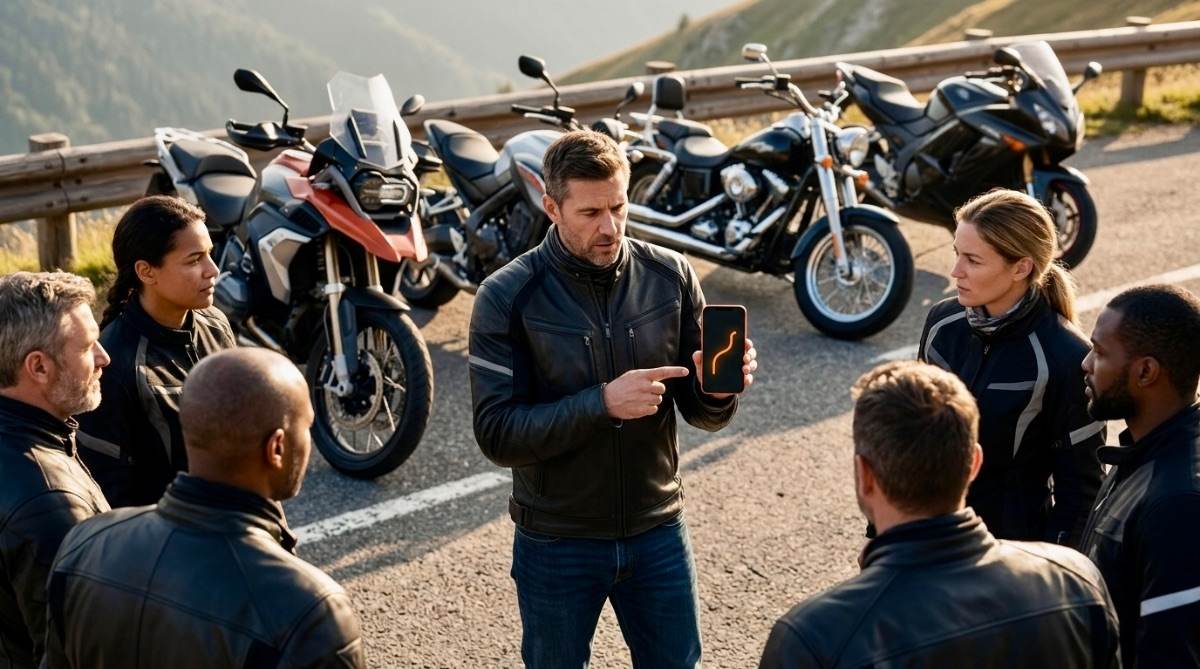
The official early start has finally arrived. If all the prior work is done, this is the moment to enjoy it. However, before turning on the engines, it's imperative to gather the entire group about fifteen minutes beforehand to deliver the famous and sacred briefing.
In this brief talk, you must emphasize undeniable conduct guidelines:
- The double-file or 'zig-zag' system for the road (each rider covers half a lane at a safe distance without overtaking in the group).
- What is the protocol if the group gets separated at a red light (wait and rejoin calmly; the rider in front will wait for us at ambiguous intersections).
It's also essential to introduce the 'staff' members. You'll need a Route Captain or Leader who navigates, and the role of the Sweeper is non-negotiable: a patient and completely trustworthy rider wearing a bright reflective vest. The sweeper will close the procession from the rear, equipped with a first-aid kit, tire repair spray, and a basic toolbox in case any bike decides to complicate the day.
Conclusion
Hearing a swarm of engines shifting gears, feeling safe and cohesive, is one of the greatest rewards for the event organizer. A well-organized ride forges unbreakable friendships in the motorcycle world and dignifies the image of our community on the road. It demands a lot of anticipation, a firm hand regarding compliance with rules, and a certain composure if minor breakdowns or adverse weather occur, but the result is worth every second you invested in developing it. Go for it, prepare in advance, and go burn some asphalt with your tribe!
Este artículo y su imagen se han elaborado apoyándose en la inteligencia artificial y siendo revisados por el equipo de MotoCorner antes de publicarse. Las imágenes son ilustrativas y pueden no corresponder a modelos o piezas reales.