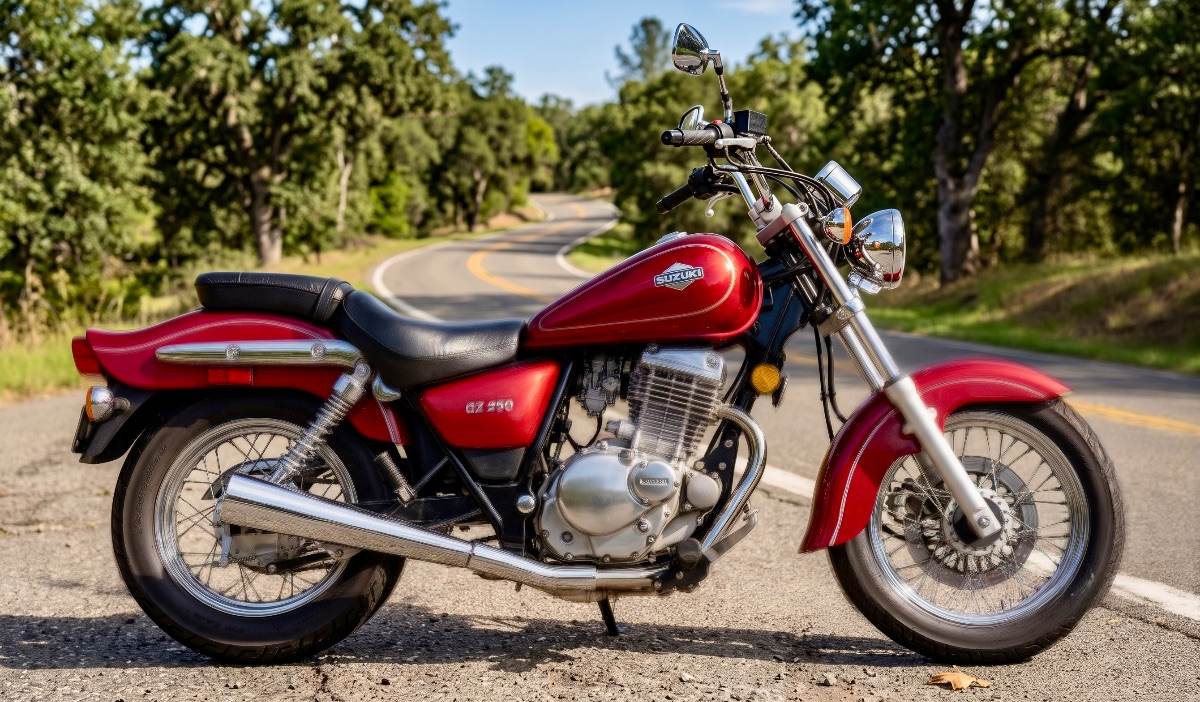
Suzuki Marauder GZ250 (2000) Maintenance Guide: Complete Manual
Discover the detailed maintenance plan for the 2000 Suzuki Marauder GZ250. Learn how to care for its single-cylinder engine, check clearances, and extend the life of this iconic custom.
The Suzuki Marauder GZ250 is, without a doubt, one of the most robust and reliable custom motorcycles for beginners ever manufactured. Heavily marketed in the early 2000s, its 249cc four-stroke single-cylinder engine has earned a reputation for being indestructible, as long as it receives proper maintenance.
In this technical guide, we will break down the service intervals, consumable specifications, and mechanical adjustments needed to keep your classic 2000 Marauder GZ250 running like clockwork. If you wish to keep an exhaustive digital record of all these intervals, we recommend adding your motorcycle to the My Garage tool to receive alerts and keep your history up to date.
Key Technical Specifications
Before we get our hands dirty, it's essential to know the precise technical specifications we'll be working with for this model:
- Engine: Single-cylinder, 4-stroke, SOHC (single overhead camshaft), 2 valves, air-cooled.
- Displacement: 249 cc.
- Engine Oil: SAE 10W-40 (API SG or higher).
- Oil Capacity: 1,300 ml (oil change only) / 1,400 ml (with oil filter change).
- Standard Spark Plug: NGK DR8EA or Denso X24ESR-U.
- Valve Clearance (cold engine): Intake: 0.03 - 0.08 mm | Exhaust: 0.08 - 0.13 mm.
- Tire Pressure (cold): Front 1.75 bar (25 psi) | Rear 2.00 bar (29 psi). If carrying a passenger, increase the rear to 2.25 bar (33 psi).
Official Maintenance Plan: Intervals
The simple design of the Marauder GZ250 engine makes preventive maintenance extremely easy. Suzuki itself stipulates periodic inspections for models of this era to ensure maximum reliability. If you want to estimate the cost of these services, you can use our maintenance cost calculator by entering the details of parts and labor.
Every 5,000 km or 6 months
- Engine Oil Change: Mandatory. As it is a small displacement air-cooled engine, the oil suffers significant thermal degradation.
- Air Filter Inspection: Being a foam type, it should be washed in a non-flammable solvent, dried, and lightly soaked in filter oil before reinstallation.
- Spark Plug: Inspect, clean the electrodes, and adjust the gap (0.6 - 0.7 mm).
- Drive Chain: Clean and lubricate (recommended every 1,000 km, but at 5,000 km, thoroughly check tension and alignment).
- Brakes: Inspect front pad wear and check the rear drum brake travel.
Every 10,000 km or 12 months
- Oil Filter: Complete replacement.
- Valve Adjustment: Mandatory inspection. As the engine has a rocker arm valve train with adjustment screws, the operation is straightforward, although it requires removing the fuel tank and rocker covers. If you don't feel confident performing this task, seek a specialist in our directory of shops and workshops.
- Carburetor: Adjust idle speed (1,300 - 1,500 rpm) and mechanical synchronization of the throttle cable.
- Fuel Lines: Inspect and replace if cracks are visible in the rubber.
Detailed Maintenance Tasks
Oil and Filter Change
To properly drain the crankcase, start the bike for a couple of minutes to warm the oil and improve flow. Turn it off, place it on a flat surface, and remove the drain plug located at the bottom (you'll need a 21 mm wrench). It is crucial to check the condition of the crush washer and replace it to prevent leaks and improper tightening.
The oil filter is located behind a small round cover secured by three nuts on the right side of the lower crankcase. When installing the new filter, ensure the rubber gasket (O-ring) is in good condition; otherwise, replace it.
Drivetrain System
The GZ250's drive kit is very exposed to the elements. The chain slack or free play should be measured at the midpoint between the front and rear sprockets by pushing the chain up and down; it should be around 15 to 25 mm. To adjust, loosen the rear wheel axle and use the integrated adjusters on the swingarm, ensuring you turn both sides equally (use the swingarm guide marks) to keep the wheel perfectly aligned.
If you notice the chain stretching unevenly, it may be time to replace the entire kit. In that case, we invite you to read our article on the lifespan of your motorcycle's components to know when to discard parts completely.
Brake Adjustment (Front Disc and Rear Drum)
The front disc brake requires checks of the brake fluid level (use DOT 4). You should bleed and replace the fluid every 2 years to prevent the spongy feel caused by absorbed moisture.
Conversely, the rear brake is a rod-actuated drum brake. Its maintenance involves adjusting the adjustment nut at the end of the rod located near the wheel, ensuring the pedal has about 20 - 30 mm of free play before engaging.
The Reliability of Fuel Injection vs. Old Carburetion
Keeping a constant-pressure Mikuni BSR32 carburetor clean is an art. If the bike will be stored for long winter periods, it is imperative to drain the carburetor bowls by closing the petcock and letting the engine consume the remaining fuel, or by opening the drain screw at the bottom of the bowl. This will prevent gasoline from breaking down and forming varnishes that clog the jets.
To put this engine in perspective within the Suzuki family of those years, the guidelines are just as demanding for classic mechanics as, for example, the maintenance of the 2002 Suzuki SV 650 S. That era of the 2000s left us with engines that were very grateful to those who knew how to change the oil on time, and exposed mechanics, accessible without fairings, that invited the user to pick up a wrench.
Conclusion
The Suzuki Marauder GZ250 (2000) is a tireless companion. Its maintenance is an amateur mechanic's dream, requiring few special tools and guaranteeing, in return, thousands of kilometers of adventures and rides. Respect the warm-up times of its air-cooled engine and always keep its chain lubrication in check.
If you've encountered any complications while checking clutch cables, chain tensions, or identifying noises from your Marauder's rocker arms, don't hesitate to start a technical inquiry thread in the motorcycle forum to ask mechanical questions, where other owners of legendary custom mechanics will lend you a hand.
Este artículo y su imagen se han elaborado apoyándose en la inteligencia artificial y siendo revisados por el equipo de MotoCorner antes de publicarse. Las imágenes son ilustrativas y pueden no corresponder a modelos o piezas reales.