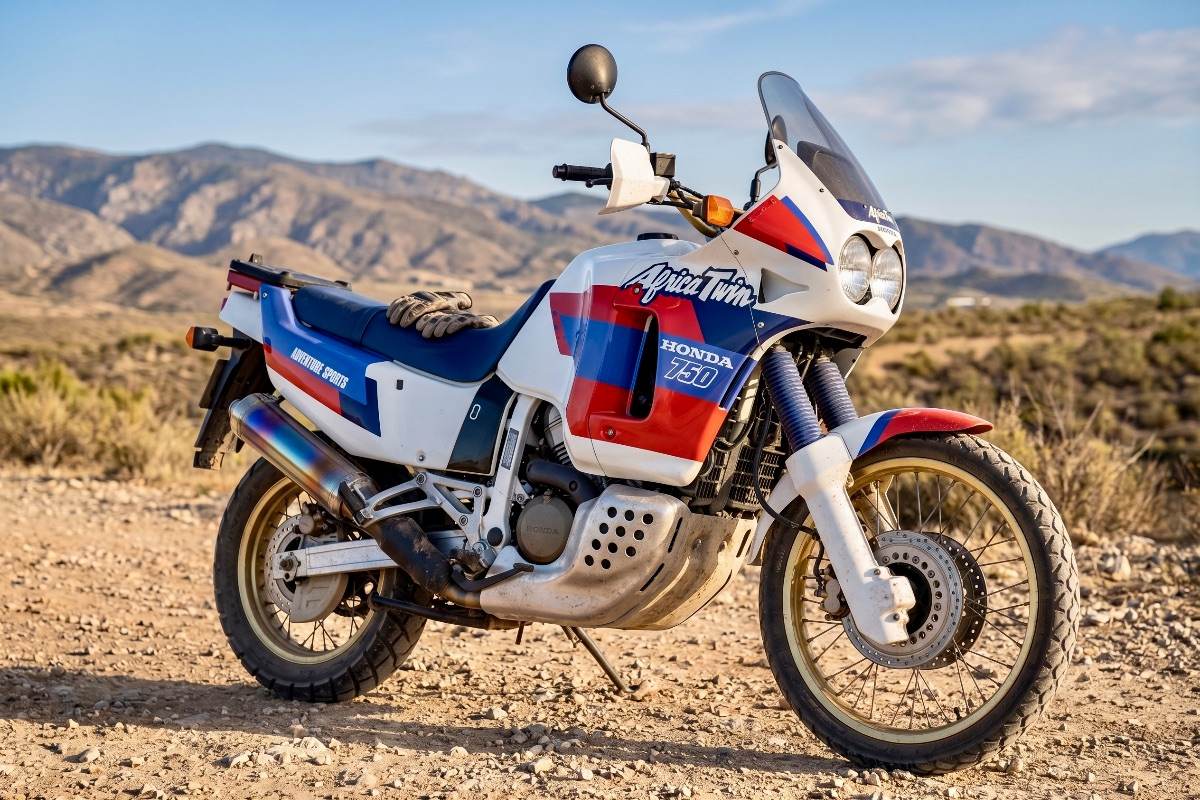
Honda XRV 750 Africa Twin (1990) Maintenance Guide: V-Twin Care
Discover the step-by-step maintenance plan for the mythical 1990 Honda XRV 750 Africa Twin (RD04). Keep your desert queen running like new.
The 1990 Honda XRV 750 Africa Twin (known by its model code RD04) is not just a motorcycle; it's a true living legend of motorcycling. Born from Honda's direct experience in the demanding Paris-Dakar rally with the NXR, the Africa Twin dominated the dunes and captured the hearts of a whole generation of riders. Its 52º V-twin engine is famous for being practically indestructible, but like any vehicle that has surpassed three decades of life, it requires care and meticulous attention.
In this Motocorner article, we will detail the specific maintenance program to keep your '90 Africa Twin impeccable, reliable, and ready for any journey, whether it's a daily commute or crossing continents.
The Importance of Maintenance on a Classic Motorcycle
Owning a 1990 model means we are dealing with a motorcycle that has classic status. Here, it's no longer just about changing the oil and clocking up miles; we face material fatigue, dried-out rubber, seals losing flexibility, and electrical connections that can accumulate rust.
If you've just acquired one of these gems or are in the process of restoring it, the first step before hitting the gas is to check out our article on care and detailing for used motorcycles, where we cover how to restore the splendor to plastics and metals that have suffered the passage of time. Additionally, you need to understand when it's time to retire your motorcycle parts to avoid jeopardizing the lifelong safety of such a heavy machine.
Official Maintenance Plan for the Honda XRV 750 Africa Twin (RD04)
Honda's original manual laid out very clear guidelines. Below, we detail them, adapted to the reality of modern oils and components, which generally offer better performance.
Pre-Ride Checks (Before each ride or every 1,000 km)
Before starting, especially on a veteran bike, adopt the routine of a visual inspection.
- Engine oil level: Check the dipstick (without screwing it in) with the bike upright.
- Drive chain: Clean, lubricate (very important to protect the sprocket), and check tension (35-45 mm slack).
- Tires: Pressure and tread condition.
- Coolant: Level in the expansion tank.
6,000 km Service (Basic Maintenance)
- Engine oil change: The V-Twin engine appreciates a good mineral or semi-synthetic 10W40 or 15W50 (if you live in very hot areas). Capacity is approximately 2.4 liters (2.6 liters if changing the filter).
- Clean oil pan and magnetic drain plug: Remove any metal shavings.
- Brake pad inspection: On this model, the Nissin calipers offered excellent feel, but they require clean pads and greased pins.
- Check lights, horn, and controls.
12,000 km Service (Intermediate Maintenance)
Things get a bit more serious here. This is the maintenance where we'll directly intervene in the fuel and ignition systems.
- Oil filter: Always replace; don't skimp on this.
- Change all 4 spark plugs: Attention! The Africa Twin RD04 has two spark plugs per cylinder. The recommended ones are NGK DPR8EA-9. The inner spark plugs are somewhat tricky to remove, so equip yourself with the original tool from the under-seat toolkit, or a thin, articulated wrench.
- Air filter: Remove the fuel tank to access the filter box and replace it. If you do a lot of off-roading, check this every 5,000 km.
- Carburetor synchronization: This is crucial for the bike to idle and accelerate with Honda's characteristic smoothness. If the bike jerks, a balancing (vacuum gauge) will solve a large part of the problem.
24,000 km Service (Major Maintenance)
- Valve adjustment: This engine uses a classic screw and locknut system. The clearance measurements (when cold) are: 0.15 mm for intake and 0.20 mm for exhaust. It's laborious because you need to remove plastics, the fuel tank, hoses, and loosen the radiators to get good access to the rocker covers.
- Brake fluid replacement: Complete bleed using DOT 4.
- Coolant change: Drain the system through the water pump screw, clean with distilled water, and use an organic coolant (50% recommended to protect the engine's aluminum).
- Fork oil replacement: On 90s suspensions, a SAE 10 or SAE 15 will make the front end less "divey" under braking.
Critical Points and Common Issues of the RD04
As mythical as it is, the Honda XRV 750 has its well-known "Achilles' heels" within the motorcycle community. Pay close attention to the following:
-
Voltage Regulator / Rectifier: This is the big problem for Honda from that era. It overheats due to its location under the tail plastics and ends up burning out. If you notice the battery boiling or bulbs constantly blowing, replace it with a modern MOSFET-type regulator. If you encounter unexpected electrical problems and don't know where to start, we recommend visiting our motorcycle forum for mechanical questions; another owner can surely lend a hand in minutes.
-
Countershaft Sprocket Shaft (Output Shaft): This is the MOST serious problem with the Africa Twin. If the chain has been too tight over the years or non-original sprockets without a damping rubber have been used, the splines on the output shaft wear down. In extreme cases, the splines disappear, the sprocket spins freely, and the bike won't move forward. Repairing this requires disassembling the entire engine and splitting the crankcases in half. Always use original sprockets (or Superpinion type) and keep the chain slightly loose.
-
Fuel Pump: It uses an electric contact (points) pump. With mileage (it usually fails after 40,000 km), the contacts become pitted, and the pump dies suddenly, leaving you stranded. A common solution is to install a diode, replace the points with new ones, or replace the entire pump with a vacuum-type Mikuni or an electric Facet pump.
Tools and Maintenance Costs
Maintaining one of these Dakar classics requires time, and if you delegate to a workshop, a lot of extra labor just to remove the heavy fairing and crash bars. Fortunately, many operations (fluid changes) can be done at home with moderate knowledge. Use our motorcycle maintenance cost calculator to help you budget annually, whether you use the bike sporadically or daily.
Conclusion
The 1990 Honda XRV 750 Africa Twin is a grateful machine. Every minute of care in the garage is repaid tenfold in smiles on dirt paths, mountain roads, or endless journeys on secondary roads. It's a motorcycle that increases in value day by day.
Remember to keep absolute track of when you last adjusted the valves or changed the fork oil. To avoid headaches with notes in lost notebooks, record everything directly in our My Garage tool for your motorcycle. Happy trails and V's to the eternal African queen!
Este artículo y su imagen se han elaborado apoyándose en la inteligencia artificial y siendo revisados por el equipo de MotoCorner antes de publicarse. Las imágenes son ilustrativas y pueden no corresponder a modelos o piezas reales.