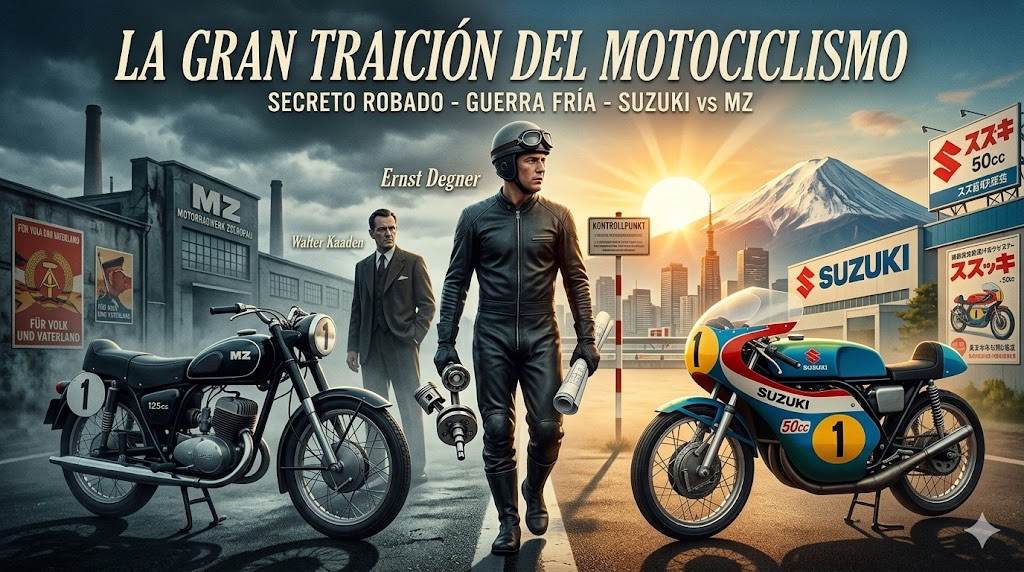
The Great Betrayal of Motorcycling: How a Stolen Cold War Secret Changed Suzuki Forever
Discover the thrilling story of industrial espionage during the Cold War, where the defection of pilot Ernst Degner with MZ brand secrets transformed the destiny of Suzuki and the world of two-stroke racing forever.
Throughout the history of motorcycling, the struggle for technological supremacy has waged epic battles on the tracks, but few stories are as fascinating, dark, and decisive as the industrial espionage case involving the East German brand MZ, engineer Walter Kaaden, its star rider Ernst Degner, and the Japanese Suzuki. This is a story worthy of a Cold War spy film that forever changed the course of motorcycle racing.
The Genius Behind the Iron Curtain
To understand this story, we must travel back to the 1950s. After World War II, four-stroke engines reigned supreme in the Motorcycle World Championship. However, in the German zone administered by the Soviet Union (which would later become the German Democratic Republic or GDR), a brilliant engineer named Walter Kaaden began working for the IFA factory, which in 1956 would be renamed MZ (Motorradwerk Zschopau).
Kaaden was no ordinary engineer. During the war, he had worked at the Peenemünde base under Werner von Braun in the development of the fearsome V-1 and V-2 flying bombs and the Messerschmitt Me 262 jet fighter. Leveraging his deep knowledge of aerodynamics and gas resonance, Kaaden set out to perfect the two-stroke (2T) engine. His experiments resulted in a revolutionary invention: the first expansion chamber exhaust with a cone and counter-cone.
This exhaust allowed the pressure wave to bounce back, closing the exhaust port and preventing fresh gases from escaping. With this innovation and the use of rotary valves, he managed to extract an astonishing specific power of 200 HP per liter from a humble single-cylinder two-stroke engine. Overnight, the small MZs became machines capable of challenging the all-powerful and expensive four-stroke bikes from Honda and MV Agusta. To learn about other "origins," visit our motorcycling history section.
The Rider, Ambition, and the Japanese Offer
The key figure in testing Kaaden's machines was the German rider and engineer Ernst Degner. Degner became Kaaden's right-hand man and MZ's star rider, achieving impressive victories that catapulted him to hero status in the GDR. In 1961, the Degner-MZ duo was virtually unbeatable and leading the 125cc World Championship.
Despite his successes, Degner was deeply dissatisfied. While his Western rivals enjoyed juicy prize money and a comfortable lifestyle, Degner earned a modest worker's salary in strict communist Germany, and victories only brought him small bonuses. The construction of the Berlin Wall in August 1961 intensified his feeling of confinement and his desire to defect with his family.
That same year, the Japanese brand Suzuki had entered the World Championship with two-stroke bikes that proved to be an absolute failure, barely managing to finish races. During the Isle of Man Tourist Trophy, Jimmy Matsumiya, Suzuki's team manager, befriended Degner. Desperate for winning technology, Suzuki made Degner an irresistible offer: a millionaire contract and help to escape to the West, in exchange for bringing with him MZ's greatest technical secrets. If you want to know more about the brand, check out our Suzuki maintenance plan.
The Great Escape from Kristianstad
Degner's escape plan was set for the Swedish Grand Prix at the Kristianstad circuit in September 1961. It was the penultimate race of the year, and Degner was on the verge of becoming World Champion.
After receiving confirmation that friends had managed to smuggle his wife and two children to West Germany in the trunk of a car, Degner put his plan into motion. During the race, while leading the pack, Degner suddenly stopped his MZ, claiming a supposed engine failure. That night, Degner disappeared from the team hotel. Taking vital parts with him (a piston, a rotary valve, a crankshaft, and Kaaden's precious technical drawings), he hid in Matsumiya's car, who drove him to Malmö to catch a ferry to Denmark, NATO territory. Keeping your motorcycle in good condition is key, find out how in the motorcycle maintenance calculator.
The Legacy: A Betrayal That Changed History
Degner's defection left Walter Kaaden completely devastated. For MZ, the blow was fatal: by not showing up for the last race in Argentina, Degner lost the World Championship, handing the 1961 title to Honda's Tom Phillis. Despite being the pioneer, the MZ brand never managed to win a speed World Championship. You can also find information on the motorcycle forum about these types of stories.
Conversely, the technological theft propelled Suzuki to glory. During the winter, Degner worked intensely with engineers in Japan, and just a year later, in 1962, Suzuki and Ernst Degner won the first 50cc World Championship with a two-stroke motorcycle. This victory marked the beginning of the end for four-stroke engines in the championship; thanks to the principles created by Kaaden and stolen by Degner, two-stroke motorcycles would completely dominate the world of competition from 1962 until the disappearance of the 125cc category in 2011.
Both the inventor and the defector had somber endings. Walter Kaaden never received the recognition he deserved from the GDR for his loyalty and genius, dying forgotten in 1996. Ernst Degner, reviled as a traitor by his home country, suffered severe burns in an accident in Suzuka in 1963, and tragically died of a heart attack (surrounded by strange speculations and rumors) in Tenerife in 1983 at the age of 52.
However, every time we hear the sharp, unmistakable roar of a two-stroke motorcycle, we are witnessing the legacy of Kaaden's innovation and Ernst Degner's bold, albeit dark, betrayal. To stay up-to-date with the latest news, visit our motor news section.
Este artículo y su imagen se han elaborado apoyándose en la inteligencia artificial y siendo revisados por el equipo de MotoCorner antes de publicarse. Las imágenes son ilustrativas y pueden no corresponder a modelos o piezas reales.