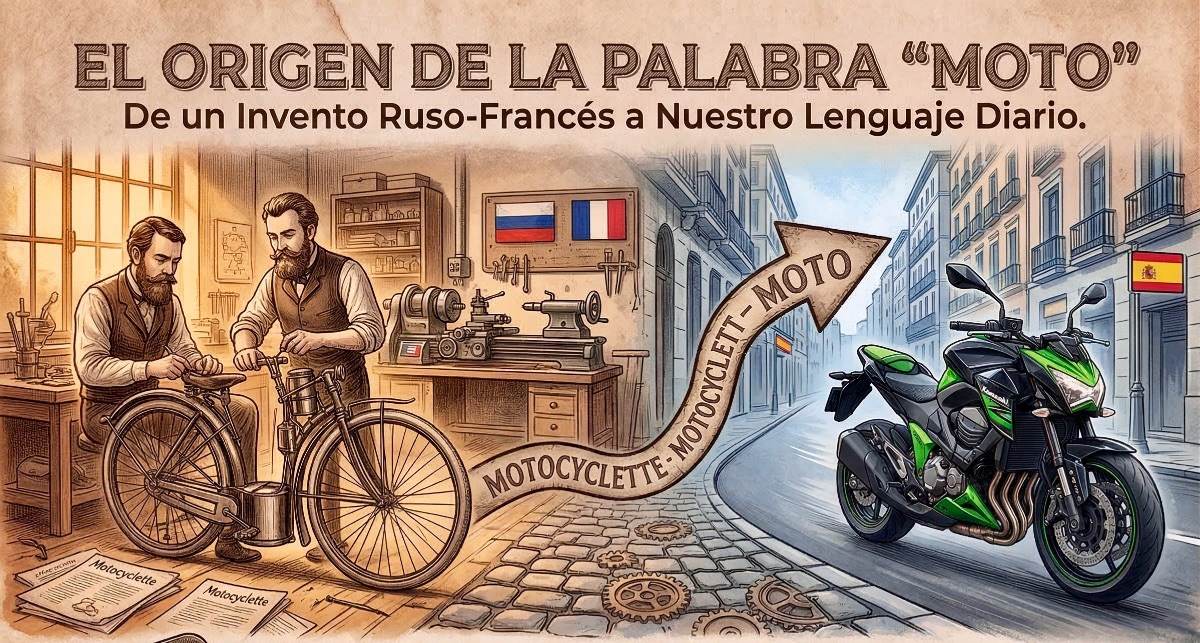
The Origin of the Word "Moto": From a Russo-French Invention to Our Daily Language
Discover the fascinating linguistic journey of the word "motorcycle." From its Greco-Latin roots and the invention of the Werner brothers in 1897, to the grammatical reason why we say "la moto" (feminine).
Every day we use the word "moto" to refer to our favorite two-wheeled vehicle, but we rarely stop to think about where this term comes from. Unlike other words that evolve organically over centuries, the word "motorcycle" is a hybrid cultism, a term deliberately designed to name a new technological category that merged mechanical traction with the balance of a bicycle.
To understand its origin, we must dismantle the word and travel back in time through its linguistic roots and industrial history.
The Anatomy of the Word: Latin, Greek, and a Touch of French
The word "motorcycle" is composed of pieces from different ancient and modern languages:
- Motor: This first root comes from the Latin motor, motoris, derived from the verb movēre (to move), which in turn is associated with the Indo-European root meuƏ- (to move away or displace). Historically, the term "motor" was used to designate the subject performing a movement, and even had theological uses in the Middle Ages (primus motor or unmoved mover) before the Industrial Revolution associated it with machines.
- Cycle: Comes from the Greek root κυκλος (kyklos), meaning wheel or circle. For the ancient Greeks, it represented both a geometric shape and the cyclical nature of life.
- The Suffix "-eta": This component comes from the French -ette, a diminutive suffix.
Therefore, from a purely morphological point of view, the original French word motocyclette meant "small bicycle with a motor."
The Werner Brothers: The True Fathers of the "Motocyclette"
Although there were earlier experiments like those of Sylvester Howard Roper in 1867 or Gottlieb Daimler in 1885, these inventors used descriptive terms like "steam velocipede" or "riding car" (Reitwagen).
The formal history of the word begins in Paris in 1897. The brothers Michel and Eugene Werner, two immigrants of Russian origin and journalists by profession, managed to create a functional model by mounting an engine on the steering head of a bicycle. They decided to christen their invention with a catchy name: Motocyclette (an acronym for motor and bicycle), and registered it as a trademark that same year.
The success of the Werner brothers' machines was so overwhelming that they suffered a phenomenon of linguistic genericization: the name of their trademark ended up being adopted by people as the common appellation for any two-wheeled vehicle with an engine. You can find more fascinating stories in our motorcycle history articles section.
Its Arrival in Spain and the Birth of "la moto"
The new word and its technology quickly crossed borders. In fact, the Royal Spanish Academy (RAE) incorporated the term "motocicleta" surprisingly quickly, including it in the supplement of the 13th edition of its dictionary in 1899.
Over time and with everyday use, the five-syllable word became long, so it underwent a linguistic process of shortening (apocope), giving rise to the word "moto." If you're looking for one, check out our used motorcycles.
This leads us to one of the most common grammatical questions in the Spanish language: Why do we say "la moto" if it ends in "o"? In Spanish, most nouns ending in "-o" are masculine, but "moto" is an exception. This is because the word retains all the grammatical properties and inherits the feminine gender from its parent word: motocicleta. When you get on your moto to record and share routes, you're surely not considering these linguistic issues.
The Curiosity of "el amoto"
As a philological anecdote, in certain rural and dialectal areas of Spain (such as in Peraleda de la Mata, Extremadura), the variant "amoto" has been documented. When saying "una moto" quickly, many people phonetically joined the "a" of the article with the noun. When the new word "amoto" was created, the natural tendency of the language to associate the "-o" ending with the masculine gender caused people to popularly start saying "el amoto." Like "el amoto," there are other customs and the curious origin of the biker greeting that have endured over time.
Este artículo y su imagen se han elaborado apoyándose en la inteligencia artificial y siendo revisados por el equipo de MotoCorner antes de publicarse. Las imágenes son ilustrativas y pueden no corresponder a modelos o piezas reales.