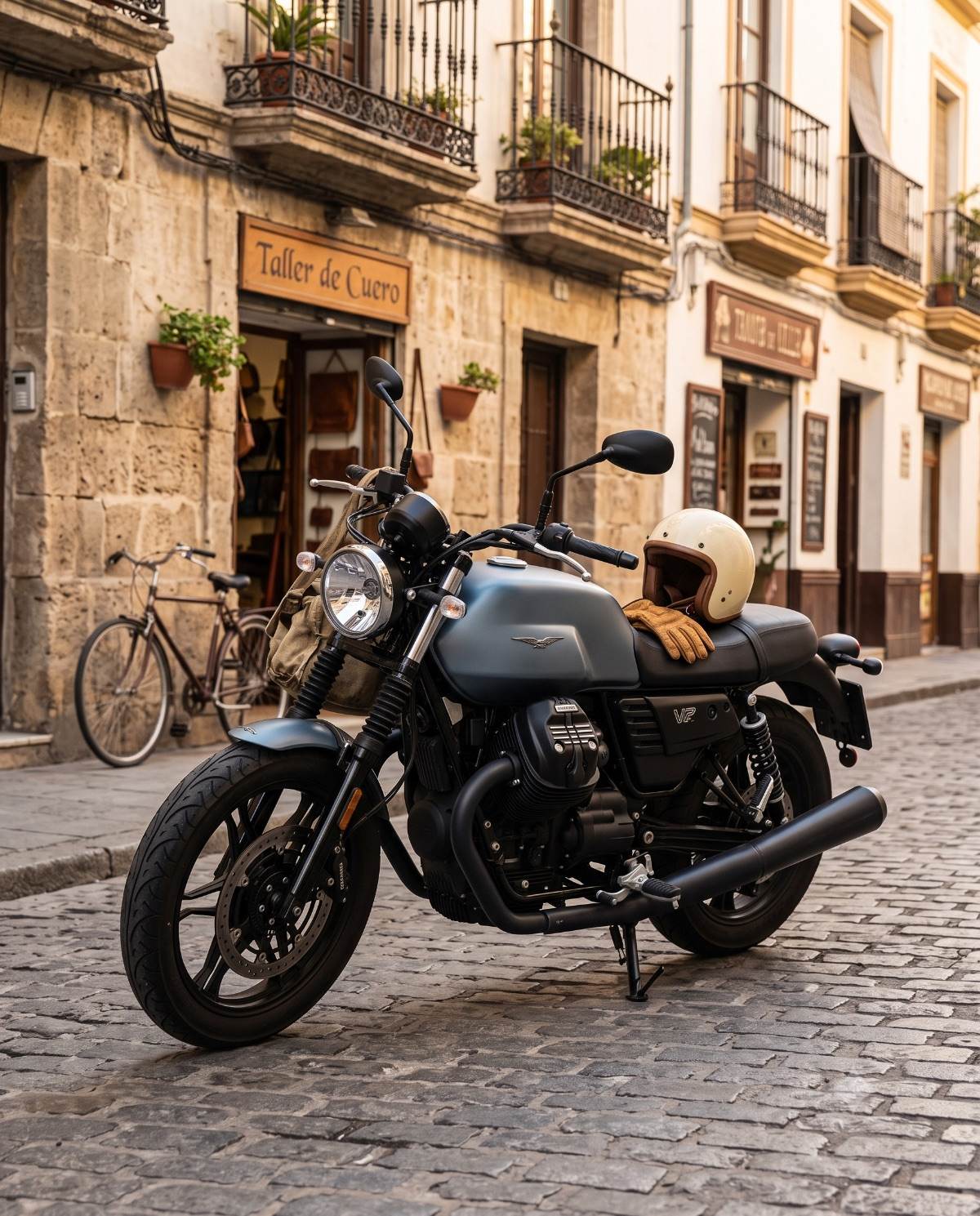
Complete Maintenance Guide for the Moto Guzzi V7 III Stone (2019): Intervals, Driveshaft, and Valves
Discover the detailed maintenance plan for the Moto Guzzi V7 III Stone 2019. Learn how to perform oil changes, driveshaft maintenance, and the classic valve adjustment of its transverse V-twin engine.
The 2019 Moto Guzzi V7 III Stone is one of those bikes that captivates not only with its impeccable neo-retro aesthetics but also with the unmistakable, primal character of its engine. Manufactured in the legendary Mandello del Lario plant, this motorcycle retains a technical architecture that is a delightful rarity today: a 744 cc air-cooled, 90-degree transverse V-twin engine with pushrods and rocker arms, and final shaft drive.
These features make its maintenance a diametrically opposed experience to that of modern, ultra-encapsulated mechanics. Its mechanical accessibility is outstanding, making it the perfect candidate for owners who enjoy getting their hands dirty. To keep a good record of your maintenance schedule, having a digital tool to manage garage maintenance is extremely useful, preventing you from skipping critical inspections.
In this in-depth technical guide, we will break down the tasks, intervals, and mandatory consumables to keep your V7 III running as smoothly (and with its characteristic vibration) as the day you bought it.
Official Maintenance Plan and Interval Chart
Moto Guzzi's service plan stipulates periodic interventions based on both mileage and the passage of time. After the crucial break-in service at the first 1,500 km (where components settle and any drivetrain debris is purged), major services are performed every 10,000 kilometers or 12 months, whichever comes first.
10,000 km Service (Intermediate)
- Replacement: Engine oil and oil filter.
- Inspection and adjustment: Valve clearance.
- Replacement: Air filter (if riding in dusty environments, reduce to 5,000 km).
- Check: Cylinder synchronization (using a vacuum gauge), idle speed, brake pad wear, physical spoke tension (if alloy wheels are fitted, check bearings).
- Lubrication: Clutch and throttle cables.
20,000 km Service (Major)
Includes everything mentioned at 10,000 km, plus the following interventions on the transmission and chassis:
- Replacement: Gearbox oil.
- Replacement: Final drive oil (Cardan).
- Replacement: Spark plugs (NGK CPR8EB-9 or equivalent).
- Replacement: Front and rear brake fluid (mandatory every 2 years, regardless of mileage).
- Replacement: Front fork oil (recommended due to seal aging).
For those who want financial visibility of these operations, it's possible to calculate fixed maintenance costs before starting with the tools. You'll find that maintaining this Guzzi is quite affordable if you apply your mechanical knowledge.
Oil Change and Critical Consumables
One of the biggest mistakes with air-cooled Moto Guzzis is using the wrong SAE grade for the engine oil. This block tends to get quite hot in city riding, requiring a very wide-spectrum, high-shear-resistant lubricant.
Engine Oil
- Required Specification: 10W-60 (100% synthetic). Castrol Power 1 Racing or equivalent meeting API SG/JASO MA standards.
- Capacity: Approximately 2.0 liters with filter change.
- Procedure: Make sure to warm the engine slightly. Remove the drain plug located at the bottom of the crankcase (installation torque 18 Nm). Also, remove the recessed spin-on filter. When installing the new one, lubricate the rubber gasket with fresh oil.
Valve Adjustment: Old-School Pleasure
As mentioned at the beginning, inspecting and adjusting the valves on a V7 III Stone doesn't require disassembling half the motorcycle like many maintenance tasks on popular Japanese naked bikes, which require freeing up space, radiators, and camshafts.
The imposing cylinder heads protrude from the sides of the tank. For adjustment:
- Engine always cold: Essential, ambient temperature.
- Remove the rocker covers by loosening their perimeter bolts. If the rubber gasket is in good condition (it usually lasts several services), you can reuse it.
- Rotate the crankshaft until the corresponding piston is at Top Dead Center (TDC) on the compression stroke. Both valves should be free of pressure.
- Tolerances: Measure with feeler gauges. Intake: 0.15 mm / Exhaust: 0.20 mm.
- If necessary, loosen the lock nut (usually 11 mm) on the rocker arm, turn the adjustment screw with a flathead screwdriver until you achieve firm but smooth friction on the feeler gauge, and then re-secure the nut, ensuring you don't lose the measurement when tightening.
This process is so straightforward that it favorably contrasts with the demanding maintenance of the iconic chain-driven V-twin engine on models like the SV 650, which use shim-under-bucket adjusters, much more problematic to get right.
Cardan and Gearbox Maintenance
The primary shaft drive system via cardan eliminates the messy chain maintenance altogether. However, the helical gears within the gearbox and the final bevel gear assembly in the swingarm require excellent lubrication with pure gear oil.
- Final Drive Oil (Cardan): Requires 85W-140 API GL-4 / GL-5 oil. Its exact capacity is only 170 ml. Do not overfill, or you will blow the seals due to overpressure. Use a precision syringe.
- Gearbox: Same extreme heavy viscosity, 85W-140. It takes around 500 ml. The gearbox oil filler plug is somewhat hidden on the right side and is difficult to refill without a small funnel or cannula.
Having this mechanism in optimal condition is what will allow you to link curves and lose yourself on better routes through Catalan roads without worrying about your transmission picking up dust, beach sand, or becoming slack.
Braking System and Chassis Safety Inspection
On the cycle side, the V7 III features a solid floating disc at the front gripped by a generous 4-piston Brembo caliper, complemented by dual-channel Continental ABS. Given the slight performance increase compared to the previous version (V7 II), the DOT 4 brake fluid suffers significant wear from thermal fatigue.
Its service life should never exceed two years, regardless of whether you've reached 20,000 km, due to its natural hygroscopic properties (gradual absorption of ambient moisture). When bleeding the brakes, pay attention to correctly tightening the banjo bolt washers (copper spacer torque at 25 Nm).
Finally, if any of these repairs overwhelm you, you lack the proper tools, or feel unsure about critical components (like bleeding the ABS system using a diagnostic pump), you can find excellent professionals by consulting our directory of workshops and stores within Spain's motorcycle ecosystem.
Conclusion
Maintaining your 2019 Guzzi V7 III Stone is a job as authentic and soulful as its riding experience. Don't fear its architecture, respect the warm-up times of its transverse V-twin engine, provide the vital 10W-60 oil, attend to the valves with the required feeler gauge, and you'll have an inexhaustible kilometer-eating machine under your seat with that unmistakable, rugged touch of a true Italian legend.
Este artículo y su imagen se han elaborado apoyándose en la inteligencia artificial y siendo revisados por el equipo de MotoCorner antes de publicarse. Las imágenes son ilustrativas y pueden no corresponder a modelos o piezas reales.