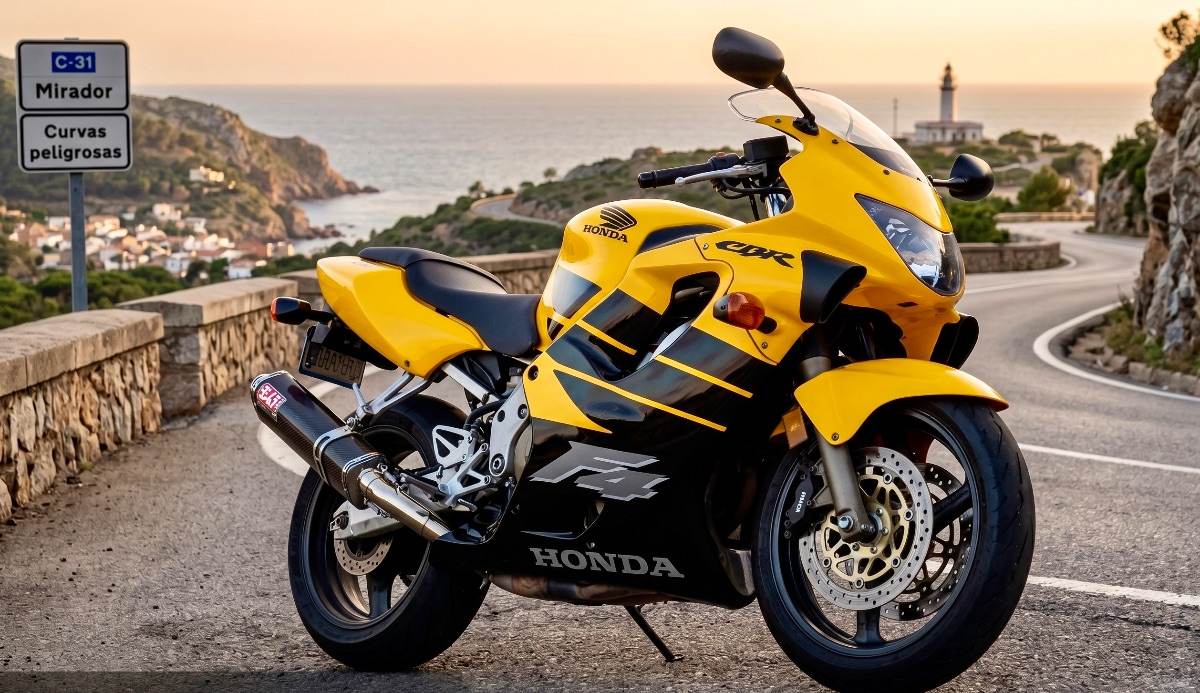
Honda CBR 600 F4 (1999) Maintenance Guide: Take Care of the Last Carbureted Legend
Discover the ultimate plan for the care and tuning of your 1999 Honda CBR 600 F4. Timing, carburetor adjustments, and key tasks for this sporty legend.
The 1999 Honda CBR 600 F4 marked the end of an era and the beginning of another. As the last carbureted evolution of the legendary CBR600F saga, this machine laid the groundwork for modern sportbikes by introducing the aluminum twin-spar frame and significantly reducing weight compared to its predecessor, the F3. However, time spares no one, not even legends.
For this 110 HP engine to continue roaring with the same smoothness as the first day, a strict maintenance schedule is vital. As this is a motorcycle with over two decades of history, regular mechanical upkeep is not just a recommendation, it's an obligation. Knowing precisely when to retire worn-out parts will make the difference between a bike that runs and a true precision machine.
General Basic Maintenance Plan
The CBR 600 F4's engine is extremely robust (it's what cemented Honda's reputation for indestructibility), but it requires quality fluids and clean filters. Officially, Honda established generous intervals back in the day, but given the bike's age, we recommend being a bit more conservative.
Engine Oil and Filter
The original manual stipulated an oil change every 12,000 kilometers. However, given its age, most experts advise performing it every 6,000 km or once a year, whichever comes first. You should use a high-quality 10W40 (or 10W30 depending on the climate) oil, preferably synthetic or semi-synthetic that meets JASO MA standards to prevent wet clutch slippage. The oil filter should be replaced with every oil change.
If you've recently purchased this bike, it's very likely that it needs aesthetic pampering in addition to mechanical attention. We recommend taking a look at the secrets of detailing for used motorcycles to restore the original shine to its bodywork and plastics.
Air Filter
Located under the fuel tank, the F4's air filter should be inspected every 12,000 km and replaced every 18,000 km. If you frequently ride in dusty areas or heavy traffic, shorten this interval to 12,000 km altogether.
The Crown Jewel: Carburetion and Spark Plugs
Unlike its modern siblings, the F4's character lies in its bank of four 36mm Keihin carburetors. Keeping them synchronized is what gives the bike that creamy, instant response when you open the throttle.
Carburetor Synchronization
It is advisable to check synchronization using a vacuum gauge every 12,000 km. You'll notice they need adjustment if the idle is unstable or the bike vibrates more than it should at low RPMs. If you've ever wondered how this process differs from electronic fuel injection, it's interesting to compare it with the maintenance of the 2009 CBR600RR, a world where maps replace jets.
Spark Plugs
The spark plugs (NGK CR9EH-9 or equivalent iridium plugs) should be inspected and cleaned every 12,000 km, and replaced mandatorily at 24,000 km. Weak ignition on this bike will lead to cold start difficulties and excessive fuel consumption.
Valve Clearance Adjustment and Coolant
Reaching the important milestone of 24,000 km, we encounter the valve clearance check. Honda engines are famous for stoically holding their adjustments, but ignoring this task is playing Russian roulette. If the valves are too tight, you'll end up burning the valve seats, and the repair bill will be very high.
On the cooling system side, the antifreeze should be completely replaced every 2 years or 36,000 km. Make sure to use organic antifreeze suitable for aluminum engines and radiators, free of silicates.
Braking System and Suspension
Returning to the chassis, the 1999 Honda CBR 600 F4 featured redesigned 4-piston Nissin calipers that provided spectacular braking. Maintaining that bite requires frequent inspection of pad thickness.
- Brake Fluid: Drain and replace with fresh fluid (DOT 4) rigorously every 2 years. The fluid is hygroscopic; it absorbs moisture, which makes the lever feel spongy and reduces braking performance.
- Fork Oil: Suspension loses its properties gradually and imperceptibly. Replace the oil in the 43mm Showa front forks every 20,000 km or 2 years using SAE 10W fluid.
If you think this list of tasks might break your budget and you won't be doing everything yourself, use our maintenance cost calculator for an estimate tailored to your situation.
Drivetrain and Bearings
The final drive kit is what connects that torrent of revolutions to the asphalt.
- Chain Tension and Lubrication: Clean the chain and apply specific lubricant every 500-800 km, or after riding in the rain. Check that the free play is between 25 and 35 mm.
- Bearings: Inspect for play in the front and rear wheels, and in the steering head bearings during major services (every 12,000 km). Notchy steering significantly impairs the CBR's agility.
We know that taking a classic to a workshop can be daunting if the mechanic doesn't know the model. Check out our directory of trusted motorcycle workshops near you in detail to find an expert craftsman in carbureted mechanics.
Organization and Conclusion
Owning a Honda CBR 600 F4 means riding a brilliant page of Japanese motorcycling history. Keeping it in factory condition ensures not only reliability but a feel that modern bikes cannot quite replicate.
We suggest noting down every liter of oil and every spark plug adjustment so that you don't miss any service. Access your private profile in My Garage, manage your bike and add all these intervals conveniently.
Este artículo y su imagen se han elaborado apoyándose en la inteligencia artificial y siendo revisados por el equipo de MotoCorner antes de publicarse. Las imágenes son ilustrativas y pueden no corresponder a modelos o piezas reales.