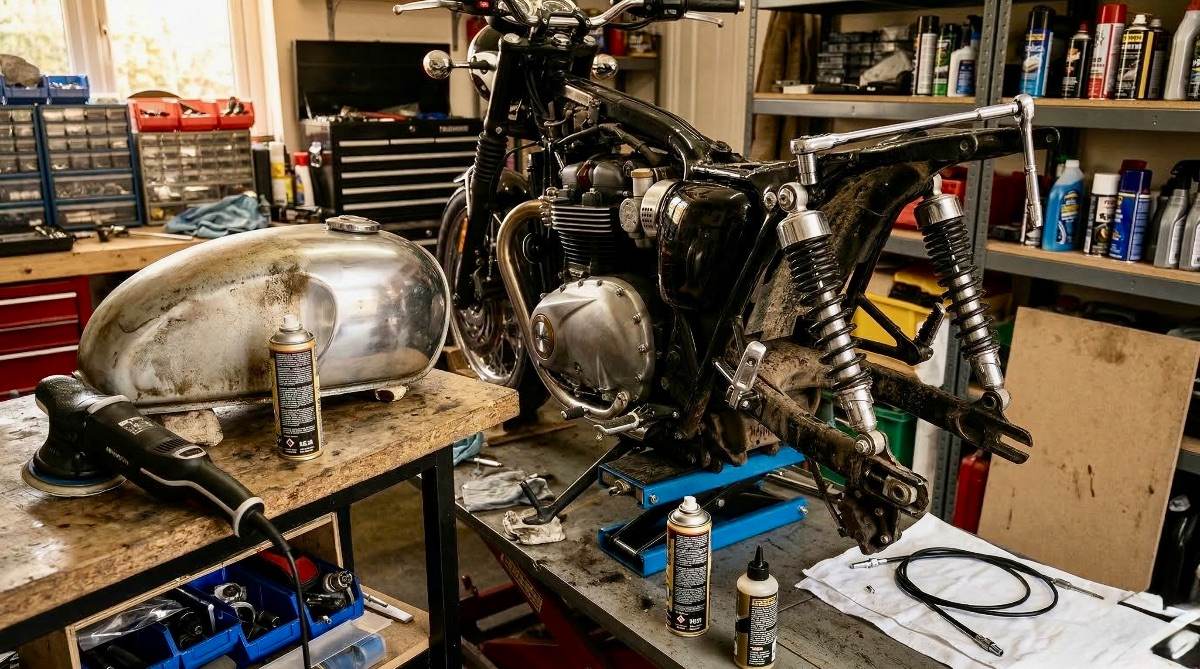
Maintenance and Detailing Guide for Used Motorcycles: Make it Like New
Buying a used motorcycle is just the beginning. Discover how to give your new companion a complete "reset": from paint decontamination and detailing, to restoring suspensions, cables, and transmission.
Acquiring a second-hand motorcycle is an excellent way to get your dream bike at an affordable price. However, no matter how good it looks, you never know with absolute certainty how its previous owner treated it.
To ride with complete peace of mind and feel that "new bike feel" again, a comprehensive "reset" is highly recommended. Here are the key steps to restore the mechanics and aesthetics of your pre-owned motorcycle.
1. The "Reset" of Fluids and Cables
The first step with any used vehicle is to establish a zero starting point.
- Oil and Filter Change: Don't blindly trust the seller's word. Change the engine oil and filter immediately to ensure optimal lubrication and remove any potential old contaminants.
- Cable Lubrication: If you notice the clutch or throttle feeling stiff, it doesn't always mean they're broken. Over time, internal friction increases. Use a "cable luber" tool and a specific lubricant spray (or syringe) to force grease through the cable sheath. This will restore incredible smoothness to the controls.
- Contact Cleaning: To prevent electrical failures (very common in older bikes), disconnect the main electrical connectors and apply a contact cleaner spray to remove moisture and sulfation.
2. Aesthetic Detailing: Rejuvenate its Appearance
A deep clean not only beautifies but also allows you to inspect the bike for leaks or loose bolts. Detailing goes far beyond soap and water:
- Decontamination with Clay Bar: Use a pH-neutral shampoo and, once dry, use a clay bar along with a lubricant (Quick Detailer). This putty traps tar particles, brake dust, and industrial contamination embedded in the paint's clear coat that a normal wash can't remove.
- Ceramic Coating: If you want to protect your investment, apply a ceramic coating (based on Silicon Dioxide or quartz). Unlike traditional wax that lasts months, a coating lasts for years, provides spectacular shine, repels water (hydrophobic effect), and protects the clear coat against bird droppings and micro-scratches.
3. Radiator: The Engine's Lung
On second-hand motorcycles, the radiator is often the most neglected part, accumulating years of insects and mud on its fins, which can lead to dangerous overheating.
- Exterior Cleaning: Never use pressure washers, as you'll bend the delicate aluminum fins. Use a damp cloth to soften the insects and then remove them with a very soft brush and a low-pressure water stream.
4. Transmission: Deep Cleaning the Drive Kit
The chain is likely to have a crust of old grease, sand, and dirt that acts like sandpaper, accelerating wear. To understand the lifespan of these parts, consult our lifespan and maintenance guide.
- Total Degreasing: Use a specific chain degreaser (never gasoline, as it damages the O-ring/X-ring rubber seals!) and a three-sided brush. Also, clean the area around the front sprocket, where a large mass of old grease tends to accumulate.
- Lubrication and Tension: Dry the chain thoroughly and apply new grease to the inner side of the links, so centrifugal force will spread it outwards as you ride. Also, check for any "seized links" (stiff ones) and adjust the tension according to the manual. You could consult an official Yamaha MT-07 maintenance plan as a reference.
5. Suspension: Regain Control
Degraded suspension makes the motorcycle unsafe and unstable.
- SAG Adjustment: The previous owner didn't weigh the same as you. It's vital to adjust the spring preload (the sag) to adapt it to your weight and usage.
- The Trick for Leaking Seals: If you notice the front fork "sweating" or dripping oil, before spending money on replacing the seals, try cleaning them. Often, the leak is due to a simple trapped grain of sand. Remove the dust cover and use a specific tool (like a Seal Doctor) or a thin piece of plastic (like an X-ray) passed under the seal to extract the dirt.
- Fork Oil Change: If the bike is more than two years old or has seen intensive use, the fork oil will have lost its viscosity properties. Changing it is key to restoring hydraulic damping capacity.
6. Tires: The Visual Trap
Don't be fooled by tires with deep tread. If the motorcycle has been stationary for a long time, the rubber is a hazard.
- Check the DOT Code: Look for the DOT code on the tire sidewall; the last four digits will tell you the week and year of manufacture. Motorcycle tires expire or "crystallize" after 5 or 6 years from their manufacturing date, losing all their grip and becoming as slippery as wood, especially in the wet. If they are crystallized, replace them immediately, always respecting the original Load Index and Speed Rating.
With dedication and these strategic care steps, your second-hand motorcycle will regain its splendor, its mechanical reliability, and provide you with thousands of kilometers of pure fun. Enjoy the ride! And to keep your expenses under control, you can use our motorcycle maintenance calculator.
Este artículo y su imagen se han elaborado apoyándose en la inteligencia artificial y siendo revisados por el equipo de MotoCorner antes de publicarse. Las imágenes son ilustrativas y pueden no corresponder a modelos o piezas reales.