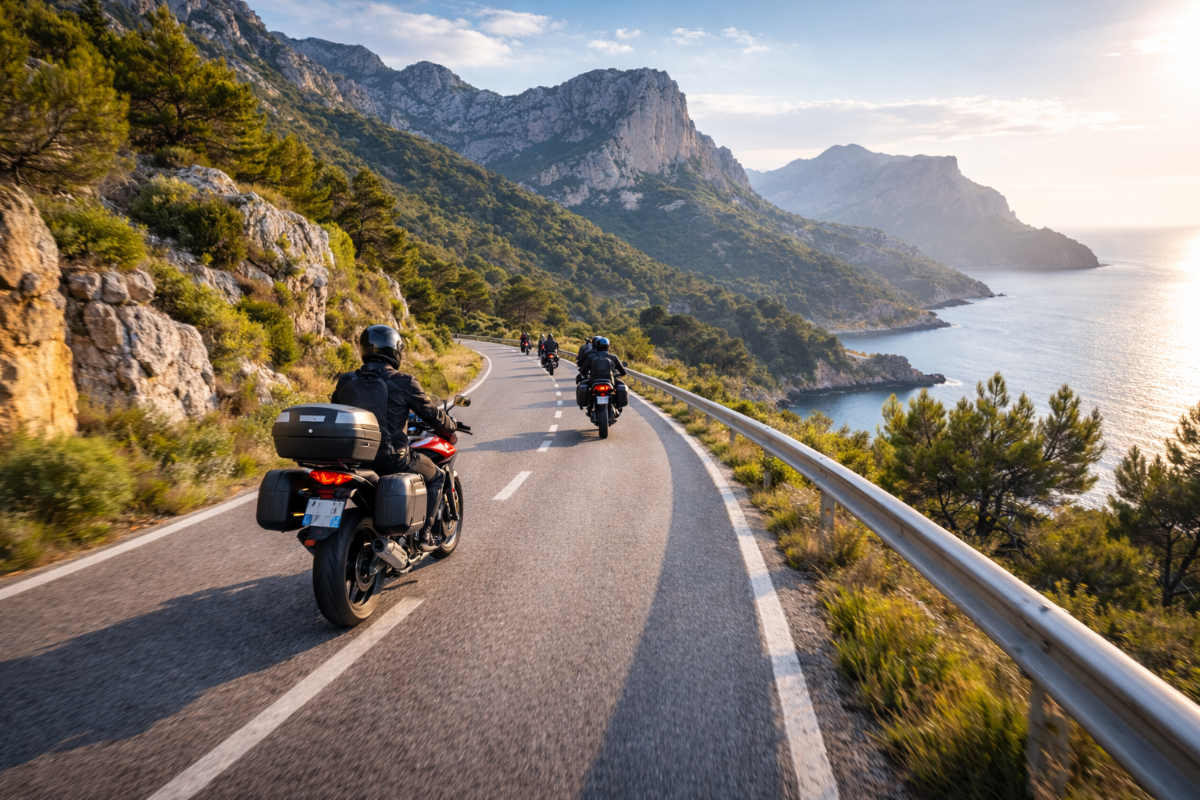
Basic rules for group rides (for clubs)
Riding in a group is cool... until someone crashes, cuts the line, or everyone goes their own way. Here are the basic rules (street smart, no showing off) to make club rides safe, smooth, and enjoyable: formation, signals, overtakes, stops, and what to do if someone gets lost.
Riding in a group is one of the best things: laughs, great rides, and that feeling of "we're in this together." But to make it fun and safe, there are simple rules that prevent 90% of scares.
No need to be military: you just need to be coordinated.
➡️ Looking for people to ride with? Join Clubes Motocorner
Before setting off: the briefing that saves rides
Before starting, 2–3 minutes of "quick chat" and you're good:
- General route (and if there are tricky sections: gravel, construction, city, etc.)
- Stopping points (coffee, gas, viewpoint)
- Target pace: chill / normal / spirited
- Who is in front (Road Captain) and who is at the back (Tail / broom)
- What to do if someone gets separated (spoiler: you'll see below)
➡️ If you don't have a route planned yet, check out ideas at Rutas
Formation: how to position yourself (without being a kamikaze)
On open roads (most common)
- Staggered formation (zig-zag): the rider behind isn't right behind your wheel, they're "in your lane" but offset.
- Why? Because:
- you can see better,
- there's more reaction time,
- and you're not in an endless single file.
In curves or when you need to push a bit
- The staggered formation is broken, and everyone rides their own line, with distance. (The important thing here is not to invade the rider in front's line.)
In the city
- Single file is better if there's traffic and cars everywhere. Less confusion, fewer scares.
Distances: not too close, not too far
The healthiest rule:
- Maintain a distance that allows you to brake without praying.
- If the rider in front is going slower, don't tailgate them: gently accelerate or leave space.
Street tip: if you're thinking "wow, I'm too close," you're too close.
Basic signals (that everyone should know)
No need to talk over intercom. You can understand each other with these:
- Pointing out a hazard on the road (pothole, gravel, oil): hand pointing down
- Slowing down / gentle braking: left hand down, moving up/down
- Stopping / gas / break: clear gesture + turn signal if applicable
- One by one (when you need to narrow up): index finger pointing up
- Ok / all good: thumbs up
If you ride with an intercom, that's great. But visual signals are still key. To supplement, you can learn more about motorcycle protective gear in 2026.
Pace and overtakes
Group pace
- The pace is set by the Road Captain, not the most eager rider in the group.
- If you're new or riding a different bike: say so beforehand. No shame in that.
Overtaking in a group (golden rule)
- Each rider overtakes on their own when they can do so safely.
- Don't "copy" the overtake of the rider in front as if you were a train.
- If in doubt, DON'T overtake. Period.
Another useful rule: if the group stretches out, the rider in front can slow down a bit to "recompose." Good management of motorcycle routes in Catalonia always helps.
Intersections, roundabouts, and traffic lights
Groups often break up here. To avoid this:
- The rider in front doesn't accelerate like crazy if they know there are intersections.
- If there's a traffic light and it splits the group, re-group further ahead.
- At roundabouts: enter with space, no sudden changes, and don't "close the door" on a fellow rider.
Simple tip: it's better to lose 30 seconds than to lose 3 bikes.
Stops and refueling
- Short and clear stops: "10 min coffee" or "15 min gas."
- Refueling: it's best for the Road Captain to ask beforehand: "Is anyone running low?" (there's always someone who stays quiet and then drama)
- When leaving the stop: orderly departure, not "every man for himself."
➡️ Need a check-up before a long ride? Find support at Tiendas y talleres
If someone gets lost or there's a problem
If someone gets lost (the rule that works)
- The person who gets lost DOES NOT speed like crazy.
- The group:
- the Tail (broom) stays with that person or manages the regrouping,
- the rest continue to a safe point and wait.
If there's a breakdown
- Stop in a safe place (wide shoulder, exit, gas station).
- 1–2 people help. The rest don't stay "in the way."
- If you can't continue, organize: tow, recovery truck, support vehicle, etc.
If there's a scare/fall
- Safety first: signal, move away from danger if possible, call emergency services if needed.
- Nobody argues about "whose fault it was" on the shoulder. That comes later. Knowing what your motorcycle's fairing is for also adds an extra layer of protection.
Quick checklist for the Road Captain
Before setting off:
- Route and stops defined
- Pace agreed (chill/normal/spirited)
- Road Captain + Tail defined
- Signals reviewed
- Minimum fuel / refueling point
During:
- Monitor that the group doesn't stretch out too much
- Regroup after intersections/roundabouts
- Short and clear stops
After:
- Route closure (everyone home safe)
- Quick feedback to improve next time
Ride safe! And don't forget to check your motorcycle maintenance calculator to keep it in top condition.
Este artículo y su imagen se han elaborado apoyándose en la inteligencia artificial y siendo revisados por el equipo de MotoCorner antes de publicarse. Las imágenes son ilustrativas y pueden no corresponder a modelos o piezas reales.